How to Choose the Best Leadership Development Coaching (Compared)
Choosing leadership development support can feel surprisingly complex. You may be comparing executive coaching, leadership training for managers, leadership consulting services, assessments, and dozens of packaged programs.
Which option will create lasting change?
The answer depends on more than budget or brand recognition. It depends on your goals, your people, and how the brain learns new behaviors.
Leadership is not a download. It is a practice. New habits form through attention, repetition, feedback, reflection, and real-world application. A compelling workshop may create insight. Though insight alone rarely changes how you respond during a difficult conversation, a high-stakes decision, or a stressful day.
The best leadership development coaching fits the development method to the problem.
Start By Identifying The Leadership Challenge
Before comparing providers, clarify what you want to change.
Are your managers struggling to delegate? Is communication creating unnecessary friction? Are experienced leaders becoming reactive under pressure? Is your organization growing faster than its leadership systems?
These challenges require different interventions.
For example:
A new manager may need foundational training in feedback, delegation, and performance conversations.
An executive navigating a transition may benefit from individualized executive coaching.
A leadership team experiencing conflict may need facilitated work around trust, communication, and team dynamics.
An organization with inconsistent management practices may need a custom development program supported by assessments and follow-up.
Ask yourself:
> What behavior would look different if this development effort succeeded?
This question moves you from vague goals: such as “improve leadership”: to measurable outcomes, such as:
Hold clearer accountability conversations.
Reduce avoidance during conflict.
Make decisions with greater focus and less reactivity.
Build stronger trust across teams.
Shift from sole contributor to strategic leader.
Create more consistent management practices.
Custom Coaching Versus Off-The-Shelf Training
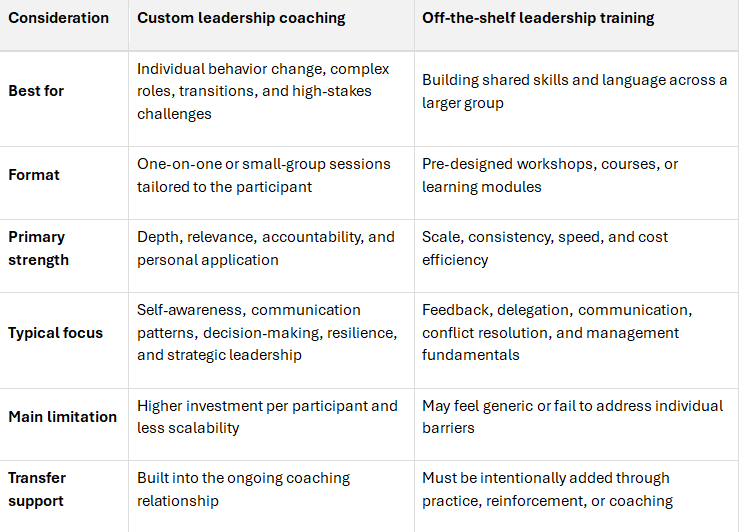
Both custom coaching and standardized training can be effective. The right choice depends on the scope of the need.
When Custom Coaching is The Better Fit
Explore custom leadership development coaching when the challenge is personal, complex, or highly contextual.
Custom coaching is especially useful when a leader is:
Stepping into a larger role.
Moving from technical expert to people manager.
Leading through growth, disruption, or organizational change.
Receiving difficult feedback about communication or trust.
Struggling with a recurring default tendency, such as avoidance or overcontrol.
Responsible for decisions that affect multiple teams or business priorities.
A coach can help you slow down enough to notice the pattern beneath the behavior.
Are you over-explaining because you do not trust your team to execute? Are you avoiding a direct conversation because you want to remain liked? Are you taking on too much because your identity is tied to being the person who solves everything?
These are not simply skill gaps. They are often connected to assumptions, beliefs, emotional responses, and learned habits.
That is where individualized coaching creates value. It gives you a confidential space to examine what is happening, test new responses, and apply them to situations that matter now.
Research on workplace coaching generally points to positive effects on outcomes such as goal attainment, self-efficacy, well-being, and leadership behavior. However, the quality of the coach-client relationship and the clarity of the goals matter. Coaching should be personalized, practical, and connected to observable outcomes: not treated as an abstract conversation.
Explore Desired Effects coaching programs.
When Off-The-Shelf Training is The Better Fit
Choose standardized leadership training when you need to build a common foundation across many managers.
This approach can work well for:
First-time manager development.
Communication and feedback skills.
Delegation and time management.
Conflict resolution.
Shared leadership language.
Organization-wide expectations for effective management.
On-demand learning for a distributed workforce.
Off-the-shelf does not have to mean impersonal. The key is how the program is designed and supported.
A 2023 evidence review from the Chartered Institute of Personnel and Development found that leadership training tends to be more effective when it includes a needs analysis, multiple learning methods, practice, spaced sessions, and organizational support.
A one-time lecture may increase awareness. A program that combines instruction, discussion, role-play, reflection, and follow-up is more likely to influence behavior.
What Brain Science Tells Us About Lasting Leadership Change
Neuroscience offers a useful lens for evaluating development programs: though you want to use it carefully.
The brain is designed to conserve energy. It relies on familiar patterns, especially when you are tired, busy, or under pressure. That is why leaders often return to old habits even after learning a better approach.
You may understand the value of listening, yet interrupt during a tense meeting. You may believe in delegation, yet take the work back when the deadline approaches. You may want to lead with curiosity, yet interpret a question as a challenge.
This is not a character flaw. It is a sign that behavior change requires repetition.
Effective leadership development will help you:
Notice your default response.
Pause before acting automatically.
Choose a more effective behavior.
Practice that behavior in realistic situations.
Reflect on what happened.
Repeat until the new response becomes easier to access.
Psychological safety matters, too. If participants feel judged, threatened, or exposed, their attention may shift toward self-protection rather than learning. A human-centered coach or facilitator creates enough trust for honest reflection while still offering direct, useful feedback.
This is why leadership development must address both technical requirements and the human experience of leading. You need tools. You also need self-awareness, emotional regulation, empathy, and the ability to stay present when the stakes rise.
Be cautious of providers who use neuroscience as a branding shortcut. Ask how brain science influences the program design. Does the program include spaced learning, practice, reflection, feedback, and real-world application? Or does it simply use scientific language to make a generic course sound more impressive?
Consider a Blended Approach
You do not always have to choose between coaching and training.
In many organizations, the strongest option is a blended pathway:
Assess the current situation.
Use training to introduce shared concepts and tools.
Apply the tools to real workplace scenarios.
Use coaching to personalize and reinforce the learning.
Measure progress over time.
Training creates a common language. Coaching helps each leader translate that language into action.
For example, a workshop may teach a framework for giving feedback. Coaching can help a manager prepare for a specific conversation with a direct report, explore the fears behind avoidance, and review what happened afterward.
This combination supports the way the brain learns best: through focused attention, emotional relevance, repetition, and feedback.
Learn more about custom coaching and training programs.
How To Evaluate a Leadership Development Provider
Use these questions when comparing leadership consulting services or coaching providers.
1. Do they begin with your needs?
A credible provider will want to understand your organization before recommending a solution.
Look for a process that explores:
Current leadership behaviors.
Business priorities.
Team dynamics.
Organizational culture.
Role expectations.
Skill gaps and limiting beliefs.
How success will be measured.
2. Is the program grounded in evidence?
Ask what leadership, learning, and behavioral science inform the approach.
You do not need a long list of technical terms. You do need a clear explanation of how the provider turns research into practical design choices.
3. Is there meaningful practice?
Leadership development should not stop at discussion. Look for role-plays, case studies, simulations, action learning, reflection exercises, and real-work assignments.
Can participants practice a difficult conversation? Can they receive feedback? Can they return to the topic later and refine their approach?
4. How will progress be measured?
Useful measures may include:
Participant goals.
Pre- and post-program assessments.
360-degree feedback.
Manager or team observations.
Behavioral indicators.
Engagement or retention trends.
Progress reviews at 30, 60, or 90 days.
Not every outcome needs to be reduced to a financial calculation. Better decision-making, stronger relationships, and improved team clarity can be meaningful outcomes when they are defined and observed.
Desired Effects offers professional assessments that can help leaders build awareness and identify actionable development priorities.
5. Does the provider understand your context?
A great coach or facilitator brings more than communication skills. They will understand the realities of leadership: competing priorities, business pressure, organizational politics, and the emotional weight of responsibility.
You are not looking for someone who simply tells you what to do. You are looking for a partner who can help you think more clearly, see your patterns, and choose your next move with intention.
Key Takeaways
Choose custom coaching for individualized behavior change and complex leadership challenges.
Choose standardized training when you need to build common skills across a larger group.
Look for programs that include practice, spacing, reflection, feedback, and follow-up.
Treat neuroscience as a design lens: not a marketing label.
Measure behavior and workplace impact, not just attendance or satisfaction.
Consider blending training with coaching for stronger transfer and sustained application.
Remember that effective leadership requires both professional capability and the willingness to show up as a human.
Leadership growth is not about becoming someone else. It is about shifting from tolerating recurring patterns to accepting responsibility for what you can change.
If you are exploring leadership development coaching, contact Desired Effects Leadership Development to discuss what might best fit your leaders, team, and goals. A conversation can help you clarify the right next step: without pressure to choose a program before you are ready.
Further Reading
Leadership development: An evidence review, Chartered Institute of Personnel and Development